Low Code Elements
A Low Code Project is built with a combination of the following elements.
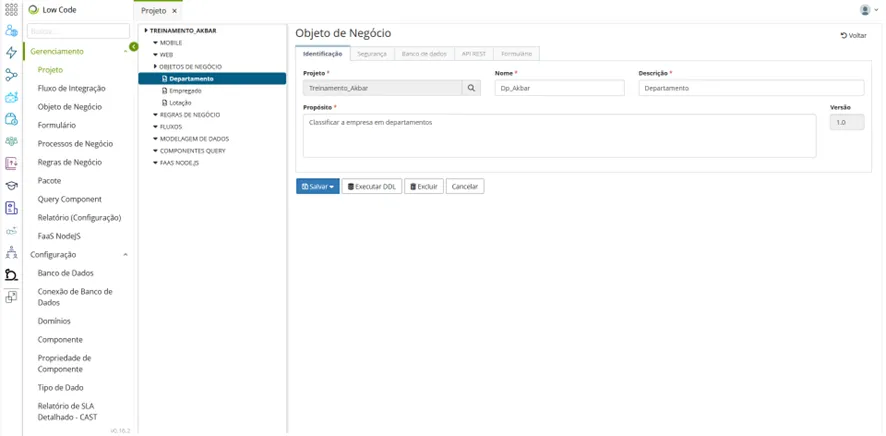
Business Object
A Low Code Business Object is an abstraction for an application data entity. Each Business Object represents the data model and is linked to a table or view in a relational database.
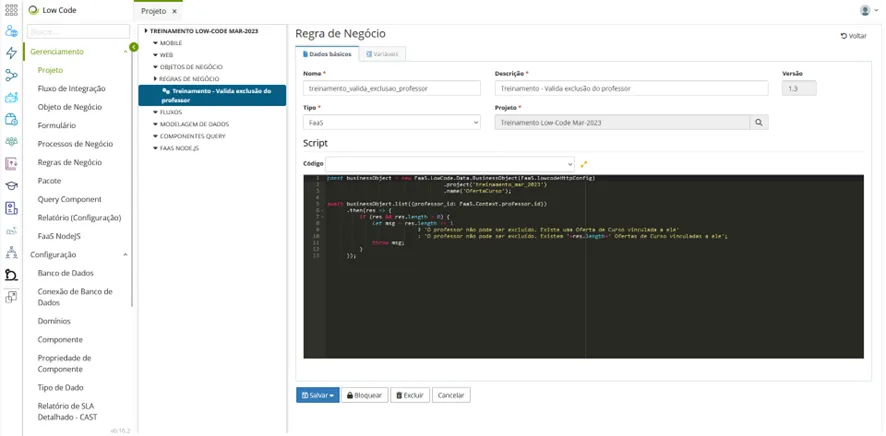
Business Rule
Low Code Business Rules are used to perform validations that reflect the business rules of the applications. They can be used for form validation and/or associated with operations to include, modify, and delete business objects.
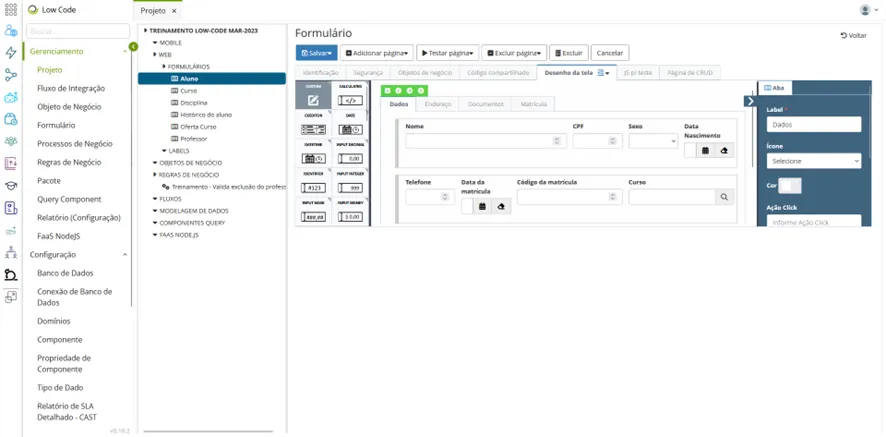
Form
The Low Code Form is where the user interacts with the application, performing operations such as querying, adding, modifying, and removing data from Business Objects, or providing information for flow execution.
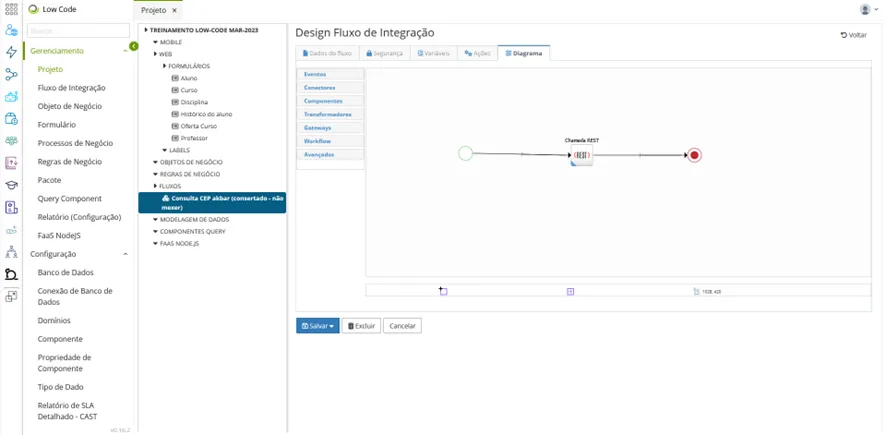
Integration Flow
Integration Flows allow the integration of Low Code applications with external systems, whether internal or third-party environments. It is an excellent option for integration with legacy systems.
Business Process
The Business Process allows the routine and automated execution of Integration Flows and interaction between Low Code elements.
Interaction of Low Code Elements
In a simple way, we can define the interaction between Low Code elements as follows:
- Business Objects interact directly with Forms and external systems (via REST API), making use of Domains and Business Rules for data validation;
- Forms natively interact with Business Objects and external systems through JavaScript/AngularJS programming. The user interface and business rules applied to the forms can be enriched using shared resources such as JavaScript, CSS, and HTML code;
- Forms also connect to Integration Flows and ITSM Service Flows, respectively, interfacing with legacy systems and the Ticket Management of Workflow and ESM.
Glossary
REST API
Representational State Transfer Application Programming Interface is an approach to creating web services that follow the principles of REST architecture. In the context of Low Code development, a REST API is a way to provide standardized web services, allowing applications or systems to communicate and interact through URLs and HTTP methods to access and manipulate specific resources. Here are some definitions related to the glossary:
API
An API is a set of rules and protocols that allow different software to communicate and interact with each other. In relation to Low Code development, an API is an interface that exposes functionalities and resources of a specific system or service.
REST
REST is an architectural style used to design scalable and flexible web services. It emphasizes the use of HTTP methods such as GET, POST, PUT, and DELETE to manipulate resources in a distributed system. A RESTful API follows REST principles, allowing interaction with resources through URLs (Uniform Resource Locators) and data exchange in JSON (JavaScript Object Notation) or XML (Extensible Markup Language) format.
Resource
In a REST API, a resource represents an entity or object, such as a user, a product, or a blog post. Each resource has a unique URL associated with it, and operations (HTTP methods) can be performed on that resource, such as getting (GET), creating (POST), updating (PUT), or deleting (DELETE) the resource.
Endpoint
In a REST API, an endpoint is the specific URL associated with a resource or an operation on that resource. For example, "/users" may be the endpoint for getting a list of users, while "/users/{id}" may be the endpoint for getting information about a specific user, where "{id}" represents a dynamic value.
In the context of Low Code development, a REST API is a way to provide standardized web services, allowing applications or systems to communicate and interact through URLs and HTTP methods to access and manipulate specific resources.